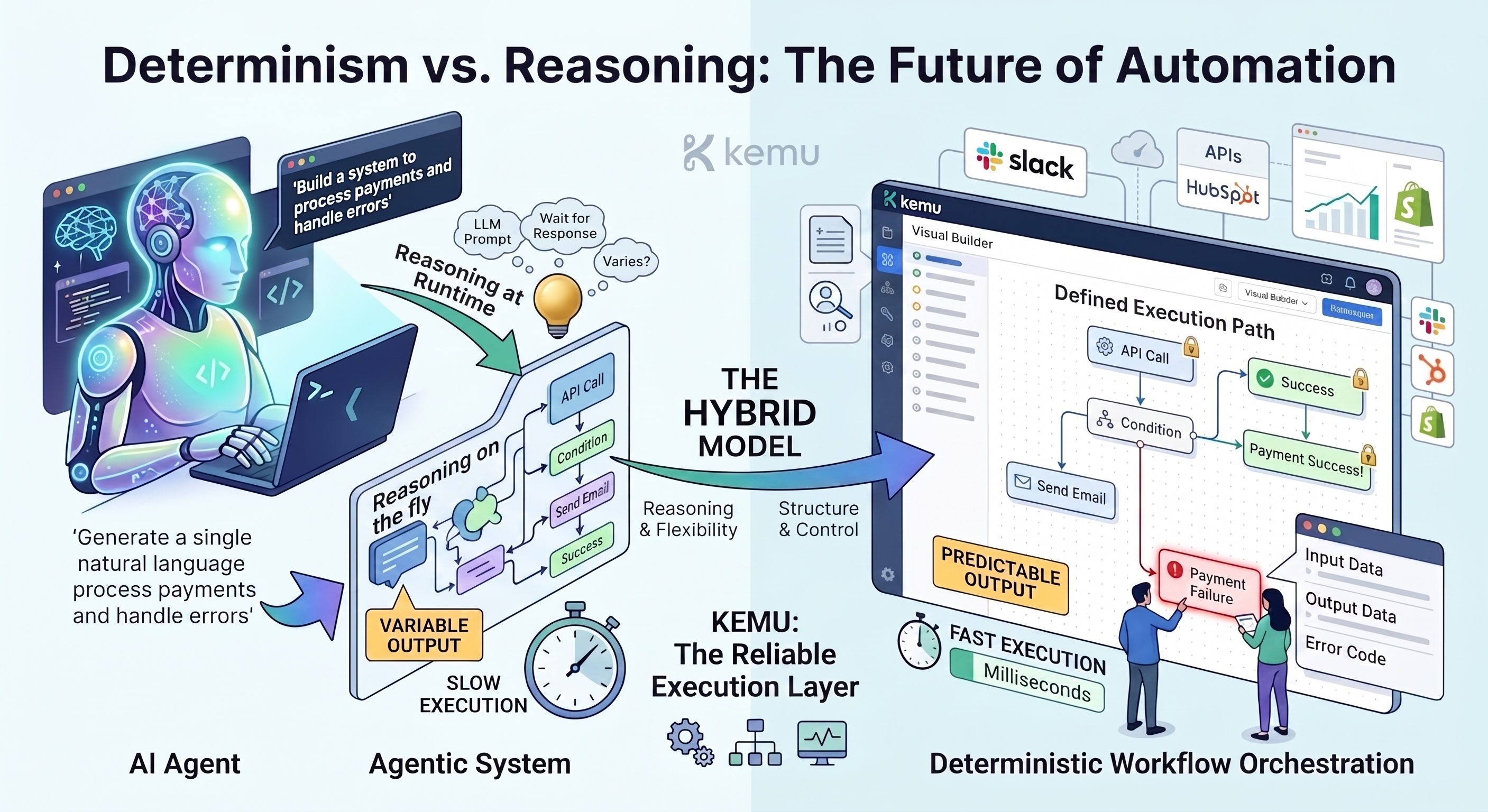
AI agents can now build and run automations from a simple prompt, but what does that actually mean for platforms like Kemu (and tools such as n8n)? This article gives you a clear mental model for how agentic systems and workflow engines fit together, when to use each, and why the future is a hybrid of both.
A growing wave of content claims that tools like Claude Code are making traditional workflow builders obsolete. The argument sounds compelling: why drag boxes in a visual builder when you can just describe a system and have an AI build it for you?
That framing misses something important. The real shift is a change in how automation is structured. When you look closely, platforms like Kemu, a deterministic workflow orchestration platform, are solving problems that purely agent-driven systems still struggle with.
In this article we'll explore what's actually happening and why the future is a hybrid of both.
The Three Phases of Automation (and Where We Are Now)
Automation has evolved in clear stages:
- Manual coding: everything written from scratch
- Visual workflows: visual builders made automation accessible
- Agentic systems: AI builds and runs workflows from natural language
Claude Code sits firmly in that third phase. It can generate entire systems from a prompt, debug them, and even iterate on them.
That's powerful, but it doesn't automatically make visual workflow tools irrelevant.
The Core Claim: "Agents Replace Workflow Builders"
The argument goes like this:
- AI agents can build faster than humans using visual tools
- They reduce the need for learning APIs or system design
- They can debug themselves
- Therefore, workflow builders are obsolete
There's some truth here. For certain tasks, especially greenfield builds, agents are dramatically faster.
But speed of creation isn't the same as reliability, observability, or control. That's where things start to break down.
Determinism vs. Reasoning: The Real Divide
The biggest difference between agentic systems and workflow platforms like Kemu is determinism.
Kemu acts as an orchestration layer. Every step in a workflow is explicitly defined, inputs and outputs are predictable, and execution paths are controlled.
In contrast, agent-driven systems rely on reasoning at runtime. That introduces variability. The same prompt can produce slightly different outputs, and the same system can behave differently depending on context, model state, or subtle input changes. Good luck debugging why.
For experimentation, that's fine. For production systems, it becomes a real risk. You don't want your payment processing flow improvising based on the model's "mood" that day.

This is why Kemu (and similar workflow tools) still matter: they enforce structure where AI alone introduces ambiguity.
Execution Speed: Fast to Build, Slow to Run
Another overlooked tradeoff is execution time.
Agentic workflows are often slow at runtime because every step involves token generation, tool selection, and reasoning about next actions. Even simple flows can take seconds or even minutes because the agent is effectively figuring things out live.
Workflow engines don't have that overhead. They execute instantly because the path is predefined, no reasoning is required, and each step is a direct function call or API request.
So while Claude Code might build something in minutes, that same system could be significantly slower every time it runs.
Kemu flips that tradeoff: slightly more setup, but near-instant execution.
Visibility and Control Still Matter
One of the biggest practical differences shows up when something breaks.
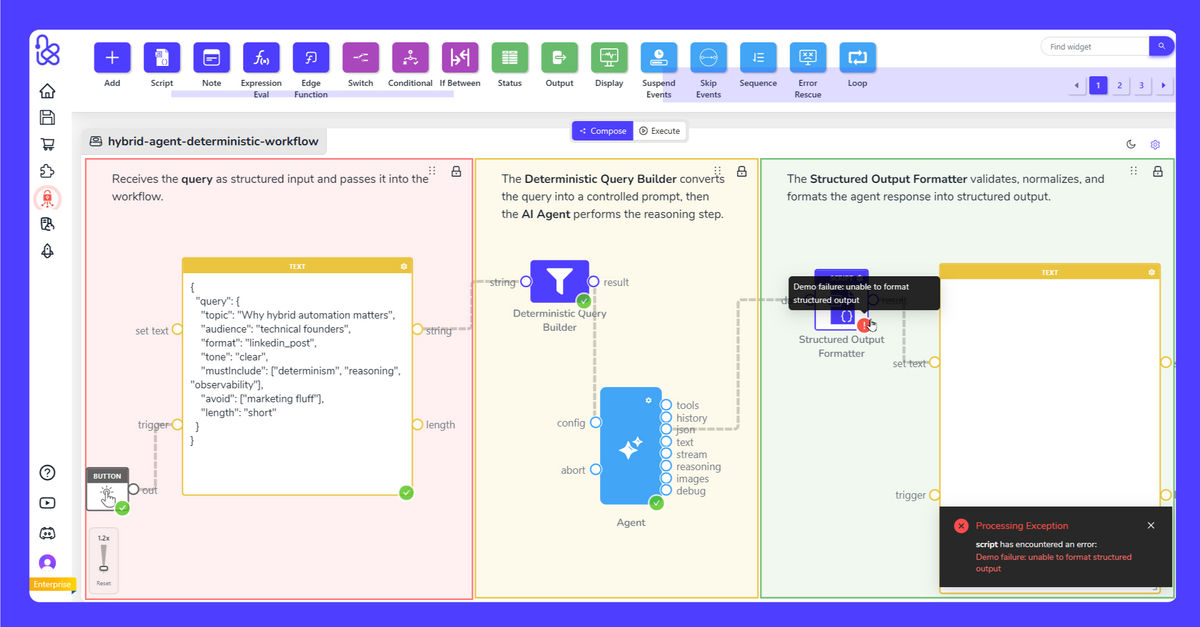
In Kemu, you can inspect each step, see exact inputs and outputs, and isolate failures quickly. The system is transparent by design.
In agent-generated systems, you often get opaque code, logic embedded in prompts or generated files, and a debugging loop that looks like "ask the AI again."
That works, until it doesn't. In production environments, that lack of visibility becomes a real constraint. When something goes wrong in the middle of the night, you want to know exactly which step failed, not start a chat session with an LLM.
Where Kemu Fits in the New Stack
Kemu isn't competing with agentic systems. It complements them.
Think of it as the execution layer that keeps things stable. You can use agents for flexible reasoning, plug them into a deterministic workflow, and control exactly when and how they run.
This hybrid model gives you the best of both worlds: AI where you need intelligence, and structure where you need reliability.
So Is Kemu Still Worth Learning?
Yes, but not for the reason people usually give.
It's not about the tool itself. It's about what it teaches: how APIs work, how systems communicate, and how to structure logic across steps. Kemu provides a visual way to describe complex systems and workflows that is easy to understand and maintain.
Those concepts don't go away in an agent-driven world. They become more important. When an AI builds something for you, you still need to understand what it built, fix it when it breaks, and adapt it to real-world constraints.
Without that foundation, you hit a ceiling quickly.
The Real Future: Hybrid Automation
The idea that agentic AI will fully replace workflow tools is too simplistic.
What's actually emerging is a layered approach: agents for creativity and reasoning, and workflow engines for execution and control.
Workflow tools remain part of that ecosystem. Platforms like Kemu extend it by focusing on orchestration and deterministic design in a world that's becoming increasingly non-deterministic.
That's not redundancy. It's necessary balance.
Because the more powerful AI becomes, the more valuable control becomes. And that's something agents alone don't give you.
Ready to get started with Kemu?
Build your own computer vision solutions without writing code. Start creating powerful ML and machine vision pipelines today.