
Visual Workflows vs. Agentic Coding: A Smarter Way to Build with AI
AI-powered coding agents are changing how software gets built. They can generate entire features, refactor systems, and even debug issues with minimal human input. On the surface, this looks like pure acceleration.
But speed without understanding can quietly introduce fragility.
Visual workflows, specifically Kemu, offer a different approach, balancing AI-driven development with human control. They provide structure that makes agentic coding safer, more understandable, and ultimately more scalable.
The Hidden Cost of "Just Let the Agent Handle It"
Agentic coding shines when you want fast output. But over time, issues creep in.
Skill atrophy is the first problem. If an AI is always writing your logic, you stop exercising the muscles needed to reason about systems. When something breaks, you're no longer equipped to fix it.
Then there's the "slot machine" effect. You prompt, regenerate, tweak, and retry, hoping the AI lands on a working solution. It feels productive, but it's often guesswork without insight.
Finally, cognitive debt: systems grow in complexity, but the team's understanding doesn't keep up. You end up with code that works… until it doesn't, and no one is quite sure why.
These problems aren't theoretical. Teams relying too heavily on autonomous agents are already hitting them.
The Shift: From Code Generator to System Orchestrator
The alternative isn't to stop using AI, it's to change how you use it.
Instead of treating AI as a replacement for engineering, treat it as a component inside a system you control.
Kemu takes this approach. It's a visual workflow platform where you build automations (called Recipes) by connecting modular components (widgets) on a canvas. Instead of burying logic inside thousands of lines of generated code, you define the structure explicitly.
You decide:
- Which parts are deterministic (scripts, transformations, routing)
- Which parts are handled by AI agents
- How data flows between them
That separation turns AI from a black box into a clearly scoped tool. You know exactly where the AI fits and where it doesn't.
Breaking the "Slot Machine" Cycle with Structure
Visual workflows force you to define how a system works, not just what you want as an outcome.
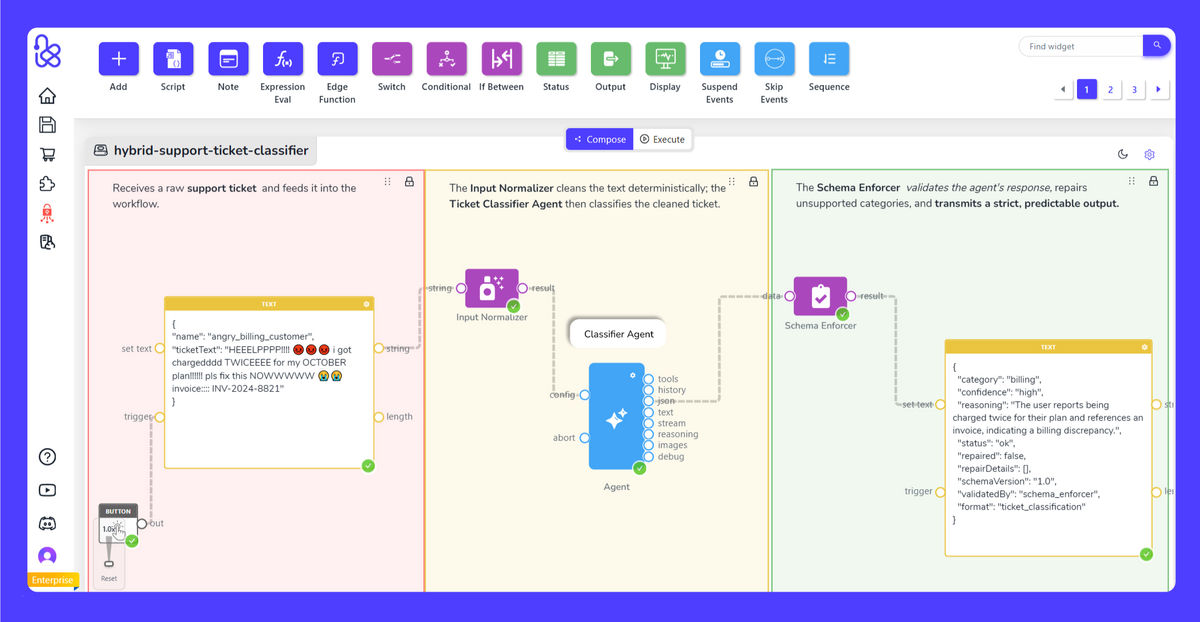
In Kemu, a Recipe is event-driven. Data enters through an Input widget, flows through transformations, and exits through an Output widget. Every step is explicit.
This changes how you work:
- You're no longer retrying prompts blindly
- You're designing a system with clear stages
- You can inspect, test, and reason about each step independently
Rather than asking an AI to "build a feature," you might use a Script widget to normalize input data, pass structured context into an AI Agent widget, then validate or post-process the output deterministically.
The result is a system that's both flexible and understandable. When something goes wrong, you know exactly where to look.
Reducing Cognitive Debt Through Visibility
Cognitive debt builds when systems evolve faster than your ability to understand them.
Visual workflows cut against this. In Kemu:
- The entire flow is visible on a canvas
- Each widget has a defined role
- Data transformations are traceable
You don't need to reverse-engineer behavior from generated code, you can see it.
This matters most for teams. A new developer can open a Recipe and understand the system architecture in minutes instead of digging through layers of AI-generated abstractions. Keep it simple until you have a reason not to.

A Practical Hybrid: Deterministic + Agentic
Kemu works best when you're not choosing between AI and traditional logic, but combining them.
Here's a simple example: a customer support classifier.
- Deterministic logic handles validation and routing
- An AI agent interprets ambiguous language
- A final script ensures outputs match a strict schema
This pattern avoids a common failure mode of agentic coding: letting the AI define both the logic and the structure.
Structure is owned by you. AI fills in the parts where it adds the most value (though you'll need to craft good prompts for those agent widgets to get consistent results).
Skill Preservation by Design
Visual workflows also encourage active thinking.
You still design:
- Data flow
- System boundaries
- Error handling
- Integration points
In Kemu, even scripts and agent prompts can be generated with AI assistance, but they're still visible, editable, and testable.
You're not outsourcing thinking. You're accelerating execution while staying engaged with the system.
This tackles the "paradox of supervision": to guide AI effectively, you need deeper understanding, not less.
Avoiding Lock-In While Staying Flexible
Pure agentic systems carry another risk: vendor lock-in and unpredictable costs.
Kemu handles this through portability and modularity.
Workflows are portable. With Edge Export, a Recipe can be turned into a standalone Node.js application. You're not locked into a single hosted environment.
AI is also just one component in the workflow. You can swap models, change providers, or adjust how often AI is used—all without rewriting your entire system.
The Bigger Picture: AI Needs Structure
Agentic coding is powerful, but without structure it leads to fragile systems and shallow understanding.
Visual workflows offer a middle path.
With Kemu, you:
- Keep control over system architecture
- Use AI where it actually adds value
- Maintain visibility into how everything works
- Reduce cognitive debt as systems scale
The goal isn't to slow down development. It's to make sure that speed doesn't come at the cost of clarity.
Because in the long run, the teams that win won't be the ones generating the most code, they'll be the ones who still understand it.
Ready to get started with Kemu?
Build your own computer vision solutions without writing code. Start creating powerful ML and machine vision pipelines today.